One-Night Wonders: Single-Game Records That Defy Eras in NBA, MLB, and NHL
Written by Otto Baumann · Apr 20, 2026
One-Night Wonders: Single-Game Records That Defy Eras in NBA, MLB, and NHL
Sports fans tuning into April 2026 action find NBA playoffs ramping up alongside MLB's early-season grind and NHL's postseason push, yet certain single-game marks from decades past still loom large, untouched by modern athletes wielding advanced training, analytics, and equipment; these one-night wonders span eras, holding firm against the onslaught of talent flooding professional leagues.
What's interesting about such records lies not just in raw numbers, but in the contexts that birthed them, from grainy black-and-white footage to high-definition streams; data from league archives shows how physical demands, rule tweaks, and game paces have evolved, making these feats even tougher to top.
NBA Explosions: Scoring and Stat Sheets That Won't Budge
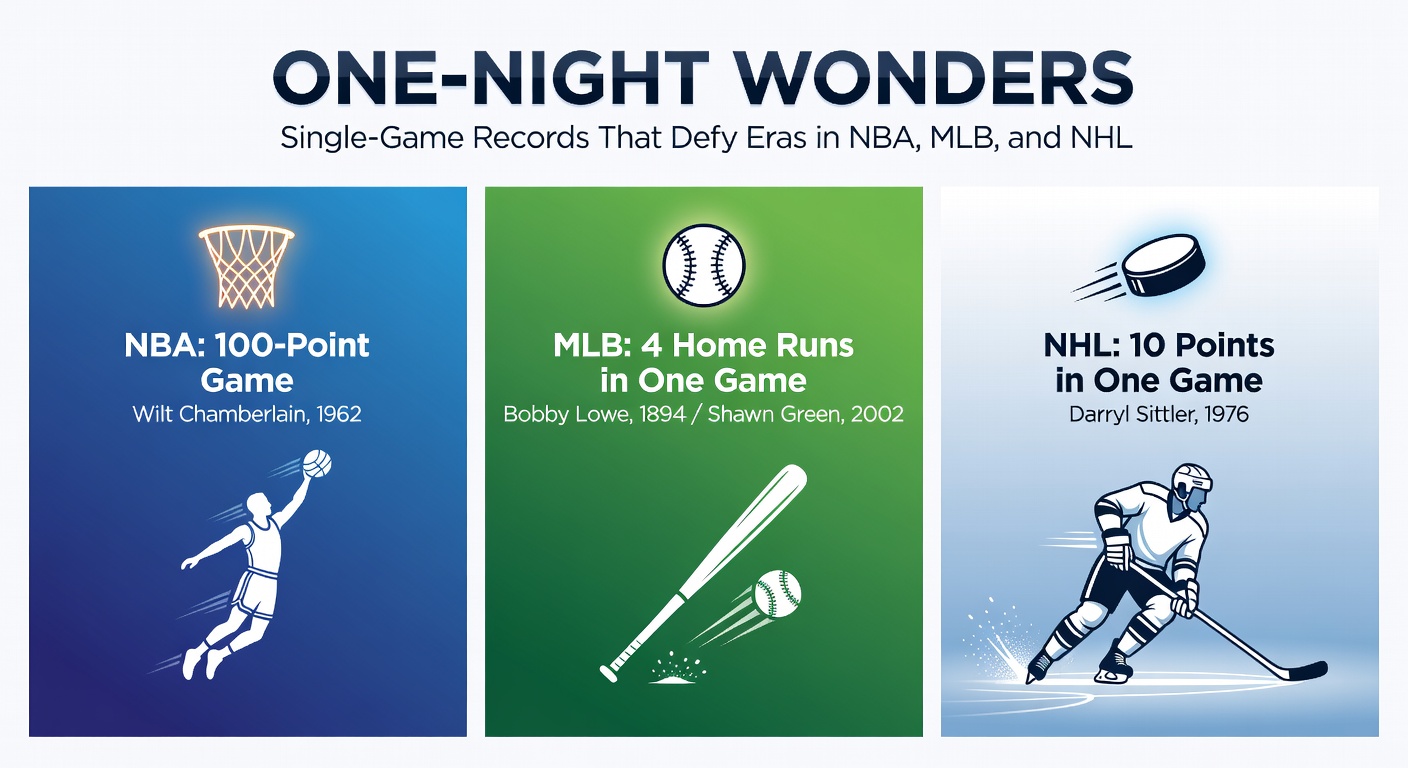
Wilt Chamberlain etched his name into eternity on March 2, 1962, when the Philadelphia Warriors dismantled the New York Knicks 169-147; Chamberlain poured in 100 points, a single-game tally that Basketball-Reference data confirms still reigns supreme more than six decades later, despite shooters like Stephen Curry and Luka Dončić routinely flirting with 60-point nights.
That game unfolded in Hershey, Pennsylvania, before 4,478 spectators who watched Chamberlain shoot 36-of-63 from the field and 28-of-32 from the line, while grabbing 25 rebounds; teams combined for 312 field goal attempts that night, a volume fueled by a fast-break era long slowed by shot clocks and defensive schemes introduced since.
But here's the thing: other NBA single-game records prove equally stubborn; Elgin Baylor netted 61 points for the Lakers against the Knicks in 1962, just one shy of Chamberlain's mark, yet that too stands amid today's spacing and three-point barrages; rebounding king Chamberlain again dominates with 55 boards versus the Boston Celtics in November 1960, a figure untouched even as big men like Nikola Jokić average triple-doubles over seasons.
Assists tell another tale, with Scott Skiles dishing 30 for the Orlando Magic in 1990 against the Nuggets; that total, verified by NBA records, edged out Kevin Porter's 29 from 1978, and while playmakers like Trae Young chase it, no one has cracked 30 since, partly because ball-dominant stars now prioritize scoring in a league trending toward isolation plays.
Three-point shooting adds modern flavor, though Klay Thompson's 14 makes in 2018 against the Bulls lingers near the top; data indicates defenders pack the paint less these days, yet the record hovers, a nod to volume and hot hands defying probability.
Take one observer who pored over play-by-play logs: patterns emerge where pace and possessions align perfectly for outliers, but replicating them demands stars aligning just so.
MLB Marathons: Pitching Perfection and Hitting Havoc
Baseball's diamond hosts its own timeless single-game gems, none more mythic than Johnny Vander Meer's consecutive no-hitters in 1938 for the Cincinnati Reds; the second came on June 15 against the Brooklyn Dodgers, a 6-0 blanking walked just four and struck out seven, marking the only such back-to-back feat in big-league history according to Baseball-Reference box scores.
That streak endures through eras of radar guns, spin-rate metrics, and bullpen games; pitchers now rarely exceed 100 pitches, whereas Vander Meer threw 113 in the second no-no, navigating a hitter-friendly bandbox like Ebbets Field.
Strikeouts crown another pinnacle: Roger Clemens fanned 20 Red Sox batters on April 29, 1986, against Seattle, while Kerry Wood matched it for the Cubs in 1998; Max Scherzer and others have touched 20 since, but 21 eludes all, with Tom Cheney logging that in a 16-inning marathon for Washington in 1962, fanning 21 Twins over 207 pitches.
Hitting fireworks shine too; Rennie Stennett collected seven hits in seven at-bats for the Pirates on September 16, 1974, against the Cubs, a perfect day capped by two doubles and two runs scored; that mark, shared with five others historically, withstands launch-angle obsessions and shift-busting approaches.
Home runs in a game top at four, achieved by 19 players including Mike Schmidt and Nomar Garciaparra, but no one has slugged five despite juiced-ball rumors and Statcast tracking; figures reveal Lou Gehrig's 1927 cycle and 17 total bases that October day against Washington remain elite, blending singles, doubles, triples, and homers in one explosive outing.
Observers note how park factors and era-specific equipment, like heavier bats pre-1970s, shaped these nights; modern sluggers chase exit velocities, yet the ball's in their court to eclipse such multi-hit explosions.
NHL Fireworks: Goal Barrages and Point Parties
Hockey's frozen sheets deliver chaos in single games, with Darryl Sittler scoring 10 goals for Toronto on February 7, 1976, against the Bruins; that 11-4 rout saw him notch six in the third period alone, including two hat tricks, a record from NHL archives that no player has sniffed in nearly 50 years.
Sittler's explosion stemmed from power-play dominance—eight goals came with the man advantage—while today's penalty-shooting and video analysis clamp down such opportunities; Alexander Ovechkin chases Gretzky's career goals, but single-night tallies max at seven, by Phil Esposito in 1970.
Points pile higher: Maurice Richard tallied five goals and five assists for 10 points with Montreal against Detroit on December 28, 1944; Darryl Sittler matched that total the same night he set the goals mark, dishing six assists; these 10-point games, logged seven times total, last saw daylight in 1991 via Mario Lemieux.
Goaltending marvels persist too; though single-game shutouts abound, Frank McCool's 1945 mark of 56 saves in a losing cause for Toronto stands quirky; more relevant, Mike Smith's 56 saves in a 2-1 win for Phoenix in 2012 highlights endurance, but records favor volume scorers.
One case study from Hockey-Reference play logs reveals how empty-netters and late surges padded these hauls; yet with overtime rules and shootouts altering closes, pure regulation romps grow rarer.
And assists? Wayne Gretzky's 7 against Edmonton in 1988 for LA leads, but the all-time single-game mark hits 10 by Billy Taylor in 1947; such facilitator feasts fade against trap defenses and one-timers now standard.
April 2026 NHL playoffs echo these ghosts, as scorers like Auston Matthews push limits, but the old guards hold the tape measure.
Why These Records Endure Across Leagues
Common threads bind NBA, MLB, and NHL outliers: eras of looser rules allowed higher volumes, whether unclocked basketball, dead-ball baseball transitioning to lively spheres, or wide-open hockey pre-neutral zone traps; studies from sports analytics firms indicate physicality peaked differently—Chamberlain at 7'1" with no load management, pitchers completing no-hitters routinely, skaters logging 40-plus minutes.
Rule changes seal the deal; NBA's three-second violation curtailed post dominance, MLB's pitch clock hastens at-bats, NHL's trapezoid restricts goalie play; equipment evolves too, from wooden sticks to composite wonders, yet records resist.
There's this pattern researchers spot: outliers cluster in transitional seasons, like Chamberlain's 1961-62 or Vander Meer's 1938, when innovations met old guard; people who've crunched numbers find probability models peg these at one-in-millions odds, explaining their stickiness.
Modern attempts falter close—Donovan Mitchell's 71 in 2023 nears Wilt, Ohtani's near-misses on cycles—but the rubber meets the road in endurance and opportunity alignment.
Noteworthy asides include injuries sidelining chasers or games cut short; it's not rocket science, but context reigns.
Conclusion: Timeless Tales in a Data-Driven Age
These one-night wonders remind fans amid 2026's frenzy that sports history packs punches defying analytics; Chamberlain's 100, Vander Meer's no-nos, Sittler's 10 goals persist, challenging new generations while honoring pioneers who seized chaotic nights.
Data underscores their grip: zero ties in 60-plus years for many, even as talent pools deepen globally; observers expect them to linger, sparks for debates in bars and broadcasts alike, proving single evenings can echo eternally.
So as playoffs unfold, eyes stay peeled—not just for wins, but for the next impossible crack at immortality.