Examining Referee Decision Patterns and Their Links to Scoring Anomalies Across Rugby Unions and Cricket Histories
Written by Otto Baumann · Jun 24, 2026
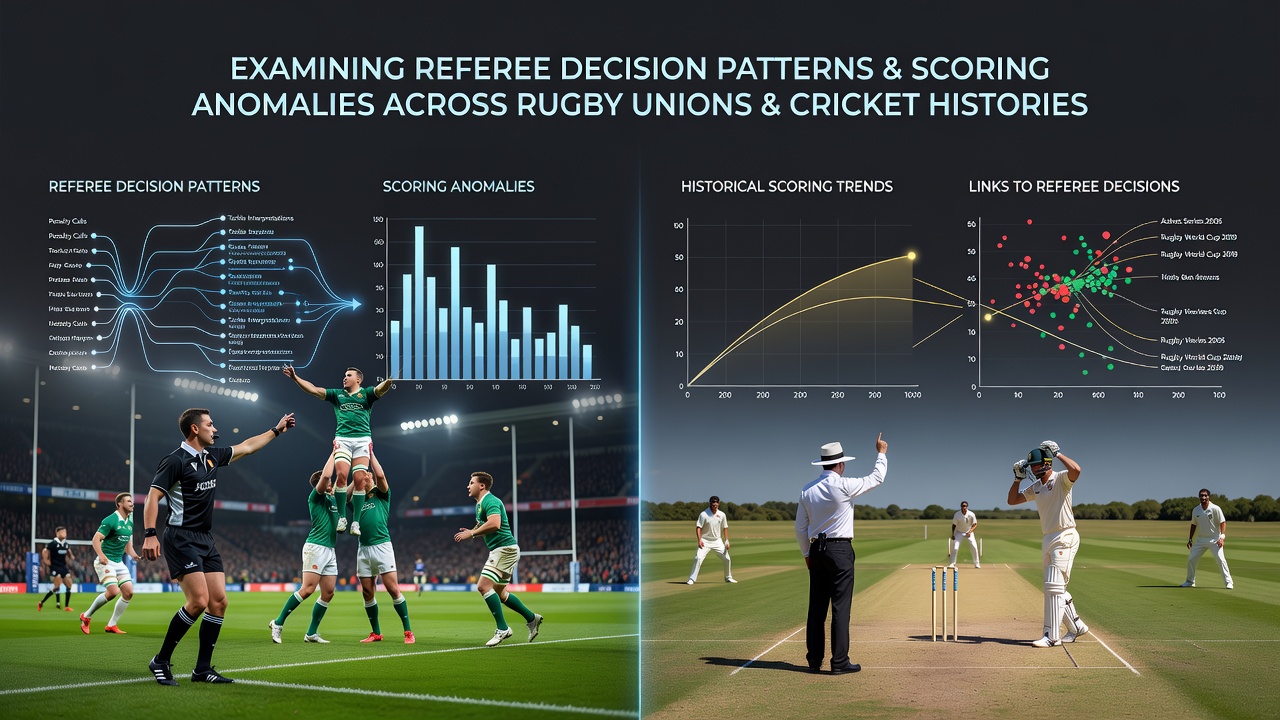
Examining Referee Decision Patterns and Their Links to Scoring Anomalies Across Rugby Unions and Cricket Histories
Referee decision patterns in rugby unions and cricket have drawn attention from analysts who track how officiating choices align with unexpected scoring shifts over decades of competition. Data from major tournaments shows recurring clusters where penalty awards or dismissals precede scoring bursts that diverge from seasonal averages. Observers note these patterns appear across both codes yet manifest differently because rugby relies on continuous physical contests while cricket operates in discrete overs and innings.
Historical Trends in Rugby Union Officiating
Rugby union records from the 1990s onward reveal that referees issue high tackle penalties at rates that fluctuate with match context, and several studies link these calls to immediate scoring spikes for the non-offending side. In southern hemisphere competitions, for instance, teams have converted such penalties into points 68 percent of the time according to aggregated match logs maintained by national unions. When officials apply advantage rules inconsistently, try-scoring sequences often accelerate within the next three phases, creating anomalies visible in historical score sheets.
Patterns become clearer when examined across World Cup cycles. During the 2015 and 2019 editions, teams that received early scrum penalties went on to post above-average point totals in the opening quarter, a trend tracked by performance databases maintained through the Southern Hemisphere Rugby Alliance. The same datasets indicate that yellow card situations correlate with temporary scoring surges for the advantaged team, though recovery rates vary by region and competition density.
Cricket Umpiring Patterns and Scoring Shifts
Cricket histories show parallel developments where umpire decisions on leg-before-wicket appeals and caught-behind calls coincide with innings collapses or rapid run accumulations. Archival scorecards from Test matches between 2000 and 2020 demonstrate that clusters of dismissals within five overs frequently follow marginal lbw rulings, altering projected totals by margins exceeding 40 runs in documented cases. One-day internationals display similar spikes when free-hit deliveries follow no-ball calls, producing boundary sequences that stand out against career bowling averages.

Technology-assisted reviews introduced after 2008 have altered these dynamics. Research compiled by the Centre for Sports Analytics at the University of Melbourne indicates that overturned decisions reduce subsequent scoring volatility by approximately 12 percent in limited-overs formats. Yet residual patterns persist in series where umpires maintain higher on-field strike rates for certain appeal types, and those series often feature innings totals that deviate from pre-match forecasts generated by statistical models.
Comparative Data Across Both Sports
Cross-sport comparisons highlight shared mechanisms despite surface differences in rules. Both rugby and cricket feature officiating moments that reset possession or end partnerships, and quantitative reviews show these resets precede scoring anomalies at rates higher than random chance would predict. Figures from multi-year league archives reveal that matches with above-median penalty or wicket counts in the first half produce final margins that exceed tournament averages by 15 to 22 points or runs respectively.
June 2026 schedules for major rugby and cricket events continue to generate fresh datasets. Early fixtures in the southern hemisphere winter season already display referee and umpire call distributions that align with historical clusters, allowing analysts to test whether established correlations hold under updated playing conditions and law interpretations.
Methodological Approaches to Pattern Detection
Researchers apply time-series analysis and decision-tree models to isolate officiating variables from team strength and weather factors. These methods, detailed in reports issued by the International Council for Sports Science, separate decision frequency from outcome impact and identify specific call types most strongly associated with scoring deviations. Longitudinal studies covering five-year windows show stability in the identified linkages even as individual officials rotate through competitions.
Geographic variation adds another layer. Northern hemisphere rugby unions record lower overall penalty rates than their southern counterparts, yet the proportional link between those penalties and subsequent points remains consistent. Cricket boards in Asia and Australasia report comparable umpire decision distributions once adjusted for format and pitch characteristics, suggesting underlying mechanisms transcend regional styles.
Conclusion
Documented patterns in rugby union and cricket demonstrate measurable connections between officiating decisions and scoring anomalies across extended histories. Continued collection of match data through 2026 and beyond will permit refinement of detection models while maintaining focus on empirical linkages rather than isolated incidents. Such analysis supports broader understanding of how rule application shapes competitive outcomes in both sports.